

By Alessio Italian Interior Design
In brief
- Foreign buyers are increasingly choosing a lake house in Northern Italy over a city apartment — for the pace of life, the light, and the landscape.
- Lake Como and Lake Garda are the two most sought-after and most exclusive lakes, with Lake Maggiore and Lake Orta offering the same beauty with slightly more accessible supply.
- All four lakes are within an hour or so of Milan and its three airports — including dedicated private aviation access for those flying in directly.
- Foreign buyers who relocate their tax residence to Italy may also benefit from Italy’s flat-tax regime for new residents.
- Buying a lake house is only step one: what actually shapes daily life in the house is the renovation — from layout to materials, room by room.
- Esperiri supports every phase: helping identify the right lake and location, navigating the practicalities of relocating, then designing and executing the renovation with Italian craftsmen.
Why buy a lake house in Italy
There’s a reason so many foreign buyers, after years of city apartments, end up looking at a lake house rather than another urban address. The Italian lakes offer something a city center cannot: a slower rhythm, framed by water and mountains, without giving up easy access to Milan, Verona or Malpensa airport. It’s wellbeing translated into geography — mornings on a terrace facing the water, a five-minute walk to a village center that has changed very little in decades, and an entirely different quality of light than anywhere else in Northern Italy.
This is precisely why buying a lake house has become such a deliberate decision, rather than an impulsive one. It isn’t a second-home purchase like any other: it’s a lifestyle choice, and it deserves the same level of scrutiny as choosing the house itself.
Which lake should you choose? Como and Garda vs. Maggiore and Orta
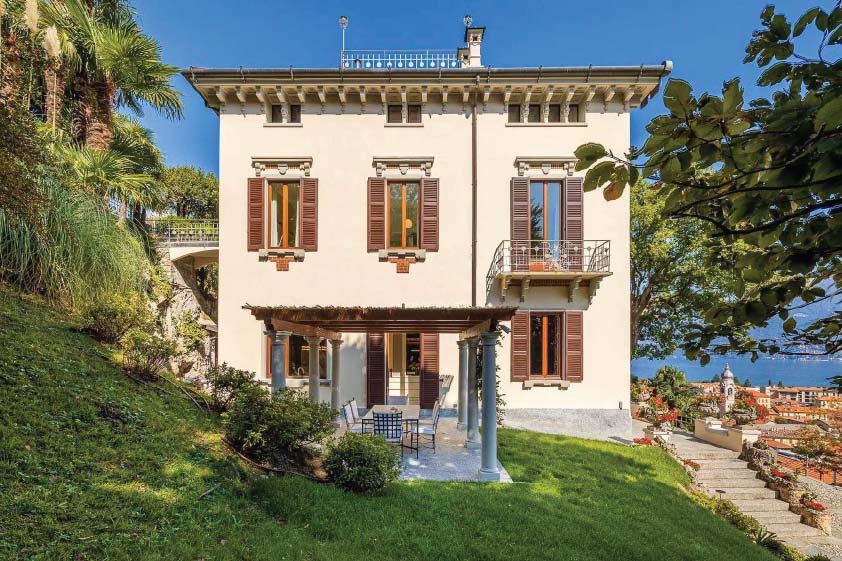
Not all Italian lakes offer the same experience — or the same level of exclusivity.
Lake Como remains the most internationally recognized and the most difficult to access. Decades of high-profile residents, historic villas, and extremely limited waterfront supply mean that a genuinely lakefront property on Como is rare, and prices reflect that scarcity. If you want the postcard image of Italian lake living — luxury hotels included — this is where demand concentrates most.
Lake Garda, the largest of the four, spans three regions (Lombardy, Veneto and Trentino) and offers a wider range of towns and price points, from the polished elegance of Gardone Riviera to the more laid-back northern shore. It’s nearly as sought-after as Como, but its scale means slightly more opportunity for buyers who want lake life without competing for the same handful of historic villas.
Lake Maggiore, anchored by Stresa and the Borromean Islands, offers a comparable landscape and a similarly refined atmosphere, but with a real-estate market that’s historically been less saturated than Como’s — a meaningful advantage for a buyer who wants exclusivity without an impossible search.
Lake Orta, the smallest and most secluded of the four, is the choice for those who want total quiet: a single small town (Orta San Giulio), a private island in the middle of the lake, and none of the tourist traffic that the bigger lakes see in summer.
Choosing between them isn’t just about budget — it’s about which version of lake life actually fits how you plan to live there. That’s the part most buyers underestimate, and it’s exactly where a second opinion from someone who works across all four lakes becomes useful before you commit to a location. It’s also where Esperiri comes in: beyond design, our team helps clients evaluate a property and its surroundings before purchase, so the choice of lake and the choice of house are made together, not one after the other.
Getting there: airports, travel times and private aviation
For buyers weighing daily practicality against exclusivity, how easily a lake connects to Milan — by road, rail or private jet — is often as decisive as the lake itself.
Lake Como is the most convenient by far: Como town is about 45 minutes from both Milan Malpensa and Milan city center, and around 70 minutes from Linate. Bellagio and the upper lake add another 30–45 minutes. For private aviation, Milan Linate is the airport of choice — open 24 hours, with a dedicated General Aviation Terminal and FBOs offering VIP handling and ground transport. Lugano Airport, just across the Swiss border, is a quieter alternative for the northern part of the lake, while Bergamo (Orio al Serio) works well for the eastern shore.
Lake Garda sits furthest from Milan by commercial routes — Desenzano, the southern gateway, is about 55 minutes from Bergamo and closer to 1h–1h15 from Milan’s center, with Malpensa the least convenient of the three city airports given its position on the opposite side of Lombardy. For private jets, Brescia’s Gabriele d’Annunzio Airport (near Montichiari) is the dedicated gateway for Garda — a quieter, more discreet alternative to Milan’s larger hubs, with easy onward access to Verona and the Dolomites as well.
Lake Maggiore is the most airport-friendly of the four: Stresa is roughly 45–55 minutes from Malpensa and about an hour from Milan’s center by train or car, making Malpensa the natural choice for both commercial and private arrivals.
Lake Orta, slightly further inland than Maggiore, runs on similar timings — around an hour to an hour and fifteen minutes from both Malpensa and central Milan.
A tax incentive worth knowing about
Many foreign buyers considering a lake house are also weighing whether to relocate their tax residence to Italy — and the country has made that decision more attractive in recent years. Under Italy’s regime for new residents (Article 24-bis of the Italian tax code), qualifying individuals who transfer their tax residence to Italy can opt to pay a fixed annual substitute tax on their foreign-source income, rather than ordinary progressive taxation, for up to 15 years — with an additional fixed amount available for family members included in the same election.
The exact figures have changed more than once since the regime was introduced in 2017, so they’re worth confirming with a tax advisor at the time of your decision rather than treating any number as fixed. What hasn’t changed is the intent: to make Italy one of the more competitive destinations in Europe for individuals with significant international income who are considering where to base themselves — a consideration that, for many of our clients, sits alongside the decision of where to buy.
This is general information, not tax or legal advice — always confirm current figures and eligibility with a qualified advisor before making a decision.
From Purchase to home: how Esperiri approaches a lake house renovation
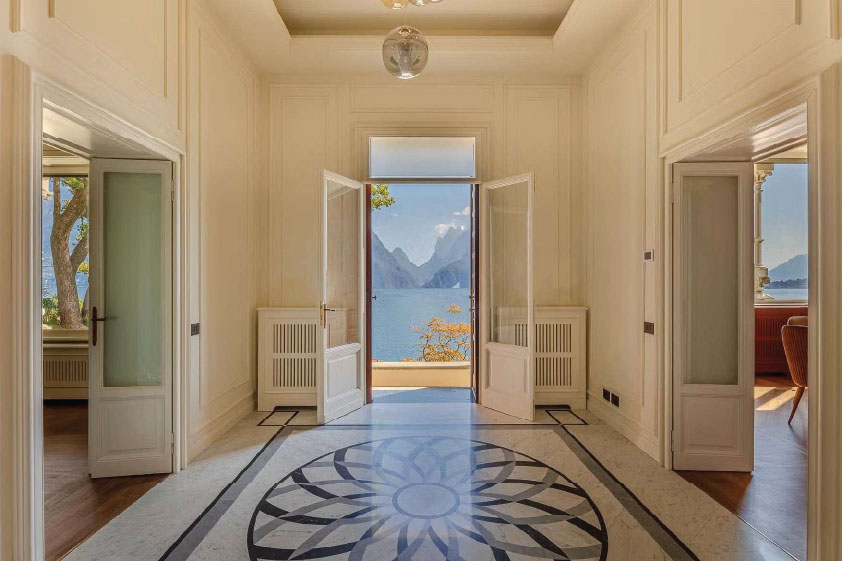
Buying the house is the beginning, not the outcome. What actually determines whether a lake house feels right — whether it becomes the retreat you imagined — is the renovation that follows. At Esperiri, that process always starts the same way: not with furniture, but with materials — the surfaces a home is actually built from, and the ones that determine how it will look in ten or twenty years, not just on delivery day.
To show what that looks like in practice, here’s how one such project — a historic lakefront villa on Lake Como, near Menaggio — came together, room by room.
The entrance hall and staircase
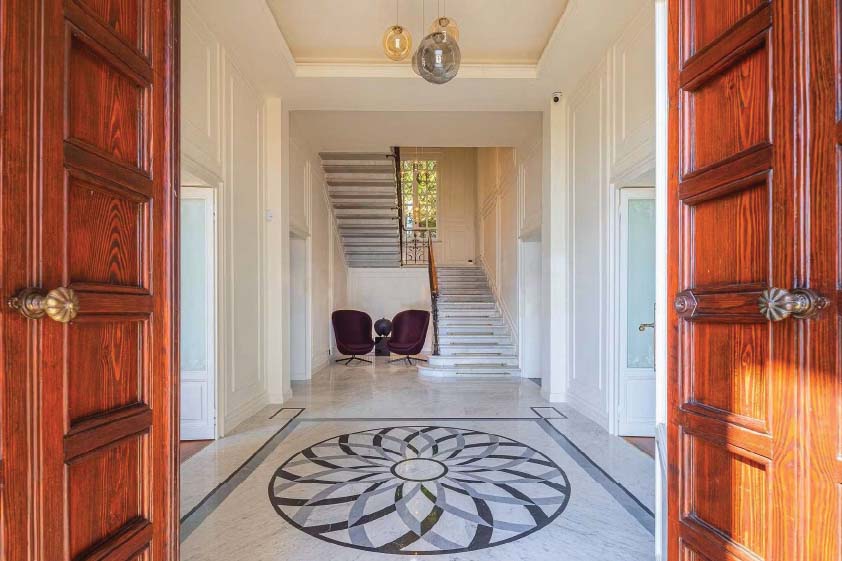
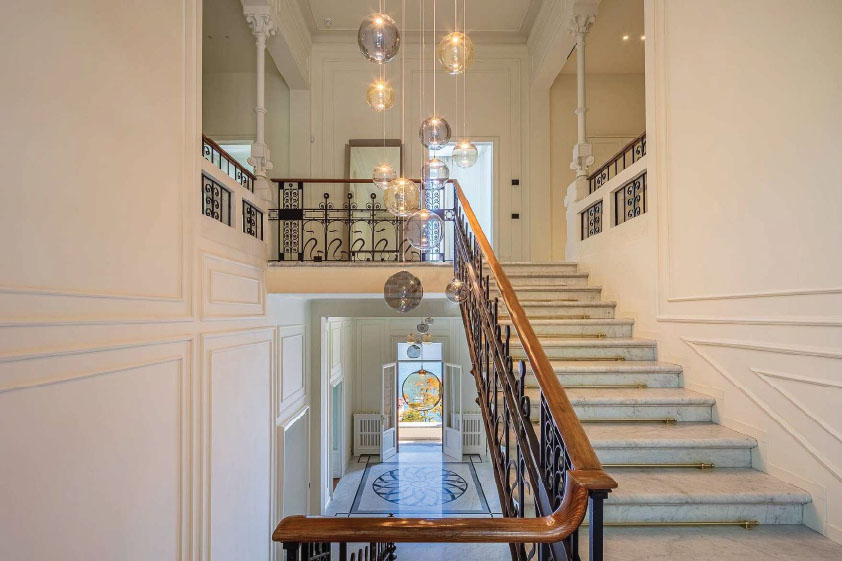
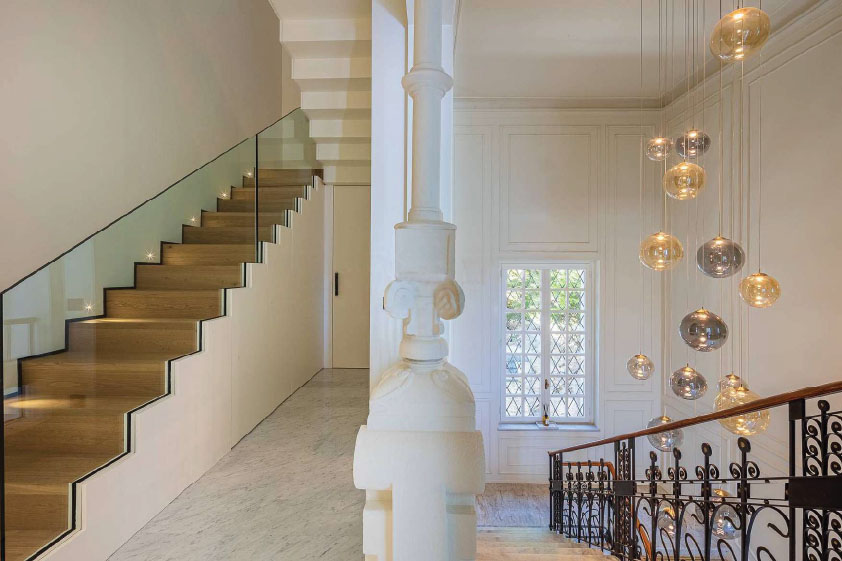
The first impression of the house was preserved rather than replaced: the original marble medallion floor in the entrance hall, with its radial geometric pattern, was restored as the anchor of the entire ground floor, exactly as it would have looked when the villa was first built. The main staircase mixes eras deliberately — antique wrought-iron balustrades and warm wood handrails alongside a newer glass-and-oak stairwell — while a cascade of blown-glass globe pendants threads through the full height of the stairwell, turning a purely functional space into one of the house’s focal points.
The living room
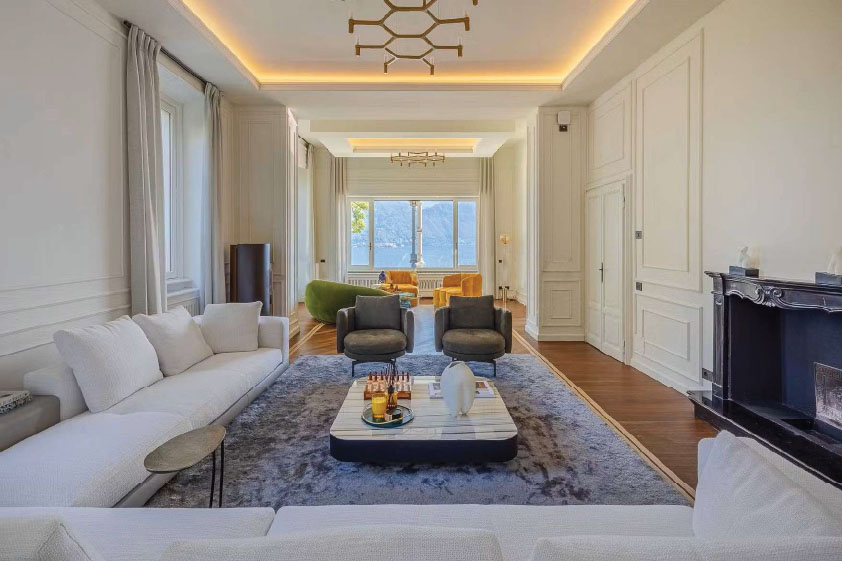
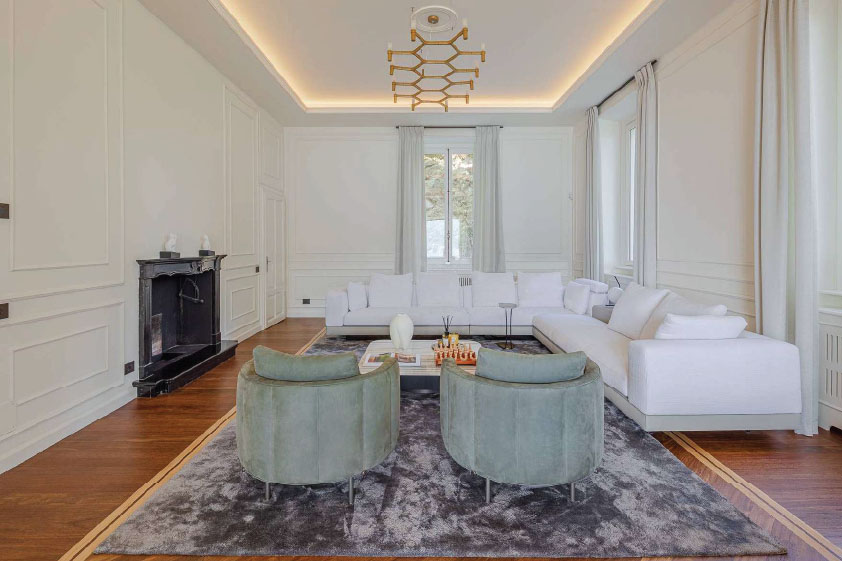
Here, the goal was to let the lake do most of the talking. Full-height windows frame the water and the mountains beyond, so the interior palette stays deliberately quiet: dark parquet flooring, white boiserie-paneled walls, and a large L-shaped sofa in off-white bouclé. A cove-lit ceiling detail and a sculptural brass chandelier — the same warm, brushed-metal language we cover in our guide to quiet luxury materials — provide the only real accent, alongside a restored antique black marble fireplace that anchors one side of the room. For more references on how a living room like this comes together, our Italian-style living room guide covers the same principles in more depth.
The kitchen
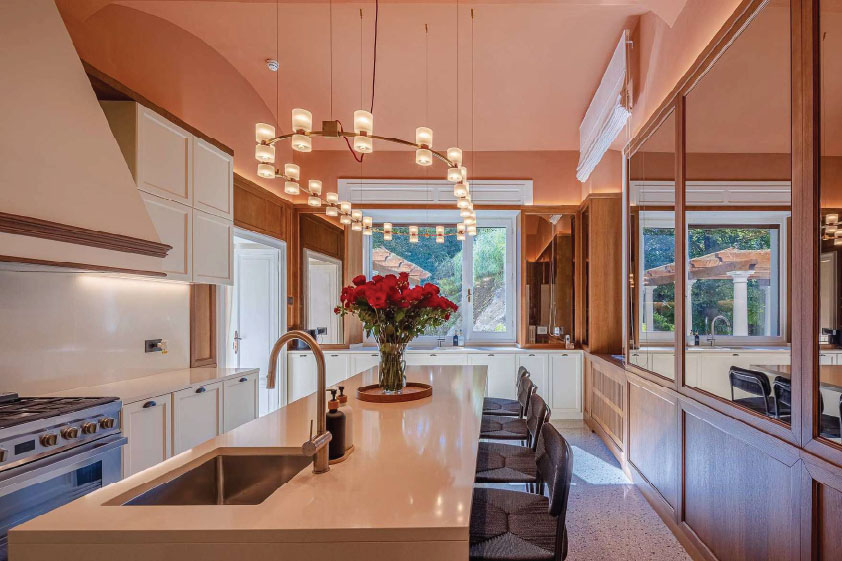
The kitchen took a warmer, more tactile direction: terrazzo flooring, natural oak cabinetry, and a large stone-topped island with a built-in sink and a professional-style range. A sculptural brass and glass pendant light runs the length of the room, while mirrored panels along one wall borrow light from the garden-facing windows and make the space feel larger without extending it structurally. It’s a good example of the balance we describe in our Italian kitchen design inspiration, where warmth and functionality are never treated as opposites.
The bedrooms
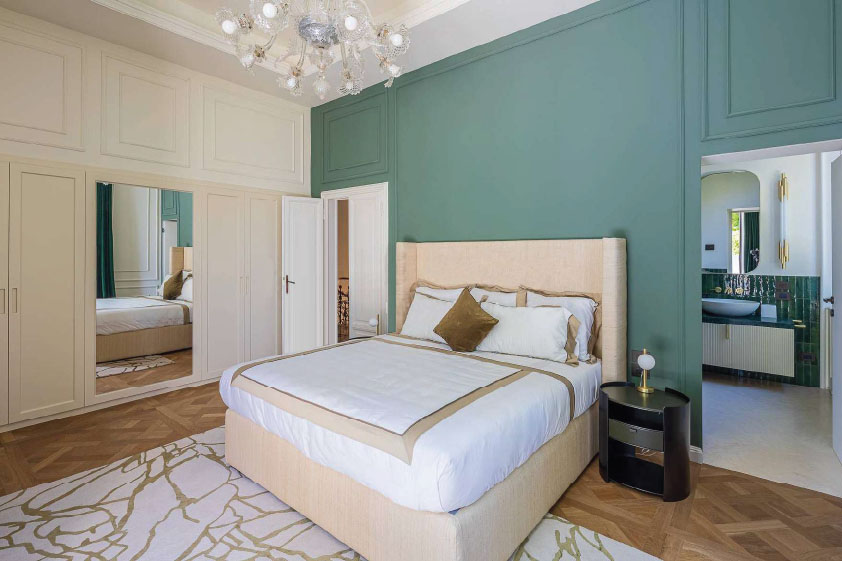
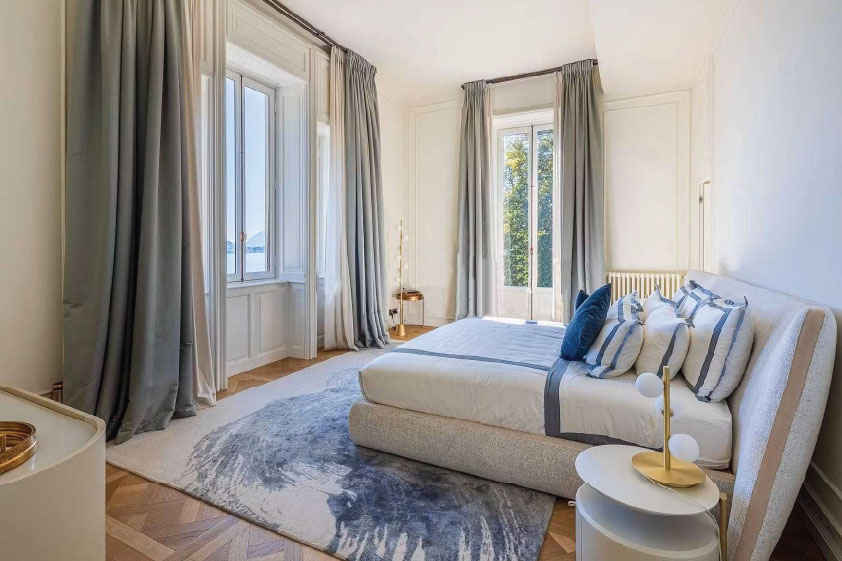
Upstairs, herringbone oak parquet replaces the ground floor’s marble and sets a softer, more domestic tone. In the primary bedroom, a deep sage-green accent wall sits behind an upholstered linen headboard, while a Murano glass chandelier reintroduces the same handcrafted glasswork found in the staircase below — a quiet way of tying the whole house together. Guest bedrooms take a cooler, more restrained palette, with heavy curtains and layered rugs in blue and grey tones for a calmer, hotel-like feel. Our Italian bedroom design guide goes deeper into these choices for anyone planning a similar space.
The bathrooms
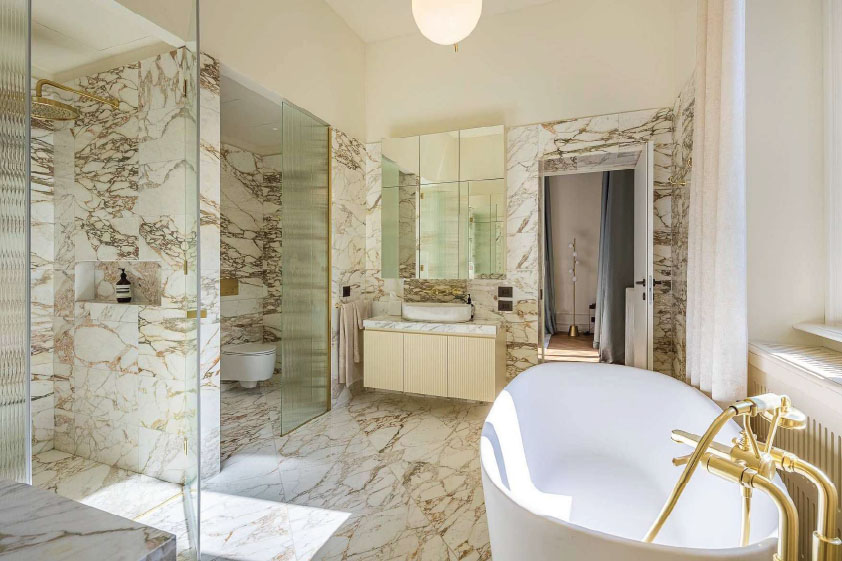
The bathrooms are where the project is most unapologetically material-led: bookmatched marble slabs, in warm cream and rust veining, cover walls and floors alike, paired with unlacquered brass fixtures that will darken and patina with use, exactly as intended. A freestanding tub sits beneath a large window, turning a functional room into one of the house’s most memorable spaces. For more on how these choices are selected and sourced, see our Italian bathroom design inspiration and our bespoke furniture service, used throughout the villa for custom vanities and joinery.
A lake house that’s built to last, not just bought
Whichever of the four lakes you choose, the lesson from projects like this one is the same: the purchase decides where you’ll live, but the renovation decides how you’ll actually live there. Every material and every room needs to be considered as part of one coherent project, not a series of unrelated choices made room by room.
If you’re at the stage of deciding which lake — and which house — is right for you, our team can help you evaluate locations across Como, Garda, Maggiore and Orta. And once the property is yours, our luxury home renovation service takes the project from design to delivery, with Italian craftsmen handling every material and detail on site.
Shop, experience, and discover Italian design with Esperiri. Milan
Frequently asked questions
Which Italian lake is best for buying a house?
It depends on what you’re looking for. Lake Como and Lake Garda are the most sought-after and offer the strongest international profile, but Lake Maggiore and Lake Orta provide comparable beauty with a less competitive market for buyers.
Is Lake Como or Lake Garda more exclusive?
Both are highly exclusive, but Lake Como has historically had a smaller pool of lakefront properties relative to demand, which tends to make it the more competitive and expensive of the two.
How far are the Italian lakes from Milan and its airports?
Lake Como is the closest, around 45 minutes from Milan center or Malpensa. Lake Maggiore is similarly quick, about an hour from central Milan. Lake Garda is the furthest by commercial routes, roughly 1–1.5 hours depending on the airport, though Brescia Airport offers a dedicated private-aviation gateway much closer to the lake itself.
What does a lake house renovation typically involve?
It usually starts with the choice of core materials — flooring, wall finishes, fixtures — before moving room by room: entrance, living areas, kitchen, bedrooms and bathrooms, each planned as part of one overall design rather than in isolation.
Can foreigners buy property on the Italian lakes?
Yes, foreign buyers can purchase property in Italy, including on Lake Como, Garda, Maggiore and Orta, though the process involves specific legal and tax steps that are worth planning for with local support before making an offer.
Does Italy offer tax incentives for foreign residents?
Yes. Italy’s regime for new residents allows qualifying individuals who relocate their tax residence to Italy to pay a fixed annual substitute tax on foreign-source income instead of ordinary progressive taxation, for up to 15 years. Figures and eligibility criteria have changed over time, so they should always be confirmed with a tax advisor.
How can Esperiri help with buying and renovating a lake house?
Esperiri supports both phases: helping evaluate lakes and locations before a purchase, then managing the full lake house renovation — from design to delivery — with a team of Italian craftsmen and designers.